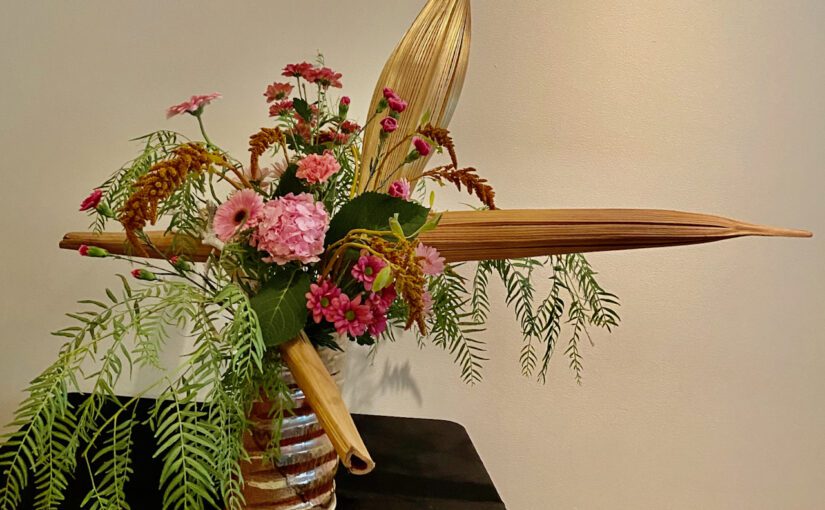
Day 24 of 30-Day Writing Challenge
Lessons I learned in ikebana (Japanese flower arrangement):
- Less is more.
- Symmetry is boring. Make asymmetry, and can you still make it beautiful?
- No two arrangements are the same, even if you use the same materials and the same container.
- Ikebana is to give a new life to flowers, with your own creativity and imagination.
- Three basic elements of ikebana: line, Mass, Color.
- Three basic techniques of ikebana: cut, bend, fix.
- The canvas of ikebana is three dimensional.
- Only one branch can express so many things – direction, movement, and energy flow.
- Ikebana reminds you of geometry class in high school: With two lines you make surface. With three lines you create depth.
- High contrast of colors, strong statement. Similar colors, harmony.
- Always consider the surroundings where you place your arrangement.
- All the flowers are beautiful, but not all the ikebana arrangements are beautiful.
- Always keep the workspace clean. Not only the final work but the process is also important.
- Always wipe out your scissors to avoid rust.
- Ikebana and calligraphy have similarity. Ikebana and music have common factors.
- We cut branches from nature and create what didn’t exist in nature before.
- You are not taking out. You are creating space.
- Space between branches and flowers are not vain, but a very important element.
- Don’t hesitate to use many materials. Don’t waste any material.
- Look closer. What do you see?nbsp; Look back. What do you see?
- Every material has the front and back. Why?nbsp; Because they grow under the sun light.
- You can only learn how flexible the branch is by actually touching and trying to bend it.
- You can’t float the branch. We are living in the world with gravity.
- You can’t take away colors from the materials. Use them.
- Scissors are a cutting tool, not a tool for putting together. When in doubt, leave the branch longer. You can always cut, but once cut short you can never make it longer.
- With only three branches you can create a basic structure of the arrangement.
- You always want a focal point.
- When arranging with many different kinds of flowers, try to place the darkest color in the center to keep the overall harmony.
- Shorter flowers in the back to add depth.
- Always keep in mind from which direction you see the arrangement. Are you placing it against the wall?nbsp; Above the eyesight?nbsp; On the floor so that people will look down upon?
- Always cut flower stems under water it will last longer.
Maybe that’s all I’ve learned in ikebana and also that’s all I teach my ikebana students.
You can read through the list less than three minutes, but it takes more than lifetime to perfect it. That’s the beauty of learning.